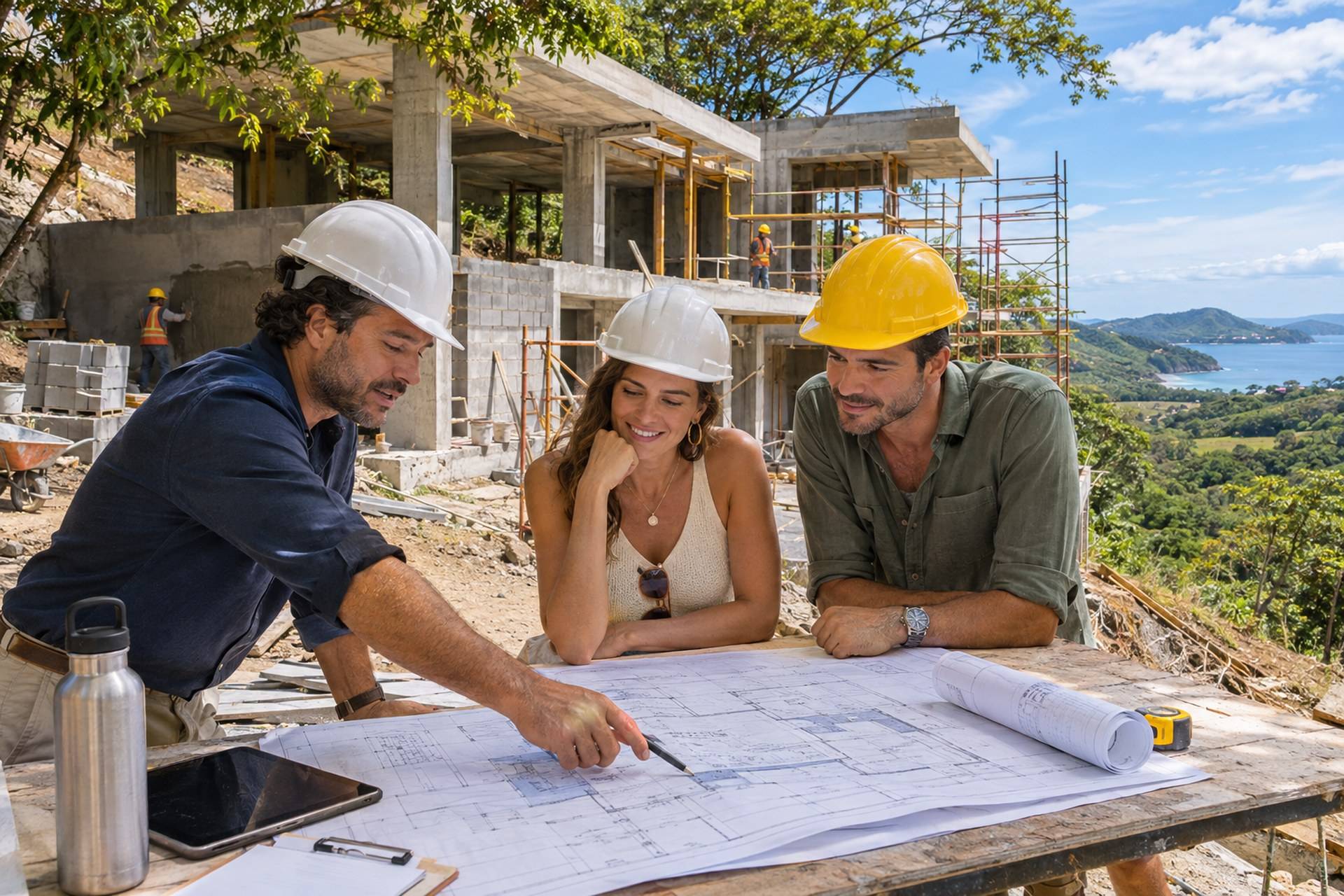
Buying a home or condo before it's built is one of the most common ways people enter the Guanacaste market, and it's easy to see why. Pre-construction prices are often lower than what finished units sell for, you can usually choose finishes and sometimes the layout, and you pay in stages. The catch is that you're buying a promise. What you have today is a set of plans, a rendering and a developer's reputation.
None of that makes pre-construction a bad idea. It means the due diligence is different from buying something you can walk through. Here's what I would check, in the order I would check it.
Start With the Developer, Not the Rendering
The most important question is whether this developer has finished projects like this one, on time and to the standard they advertised. Visit the completed projects, talk to the owners (not only the ones the developer introduces you to), and ask what happened with delays, change orders and punch lists. Ask how the project is being financed too. A developer who is funding construction from buyer deposits alone is in a different position from one who has paid for the land and arranged construction financing.
Costa Rican consumer-protection rules also cover the sale of property that hasn't been built yet. As I understand them, developers offering these contracts are expected to register with the Ministry of Economy, Industry and Commerce (MEIC) and to use a contract that has been reviewed. Ask the developer to show you their registration, and ask your attorney to confirm which protections apply to your contract.
Confirm the Land and the Paperwork
The developer should own the land you're buying into, and it should be free of liens or annotations that could affect your unit. A title search is quick and inexpensive, and I walk through it in the post on title search and due diligence. Beyond title, ask to see the permits: the municipal construction permit, the plans registered with CFIA (the professional association of engineers and architects), and environmental approval where it applies. Ask for the water availability letter too, because a project without a confirmed water supply has a problem no finish upgrade will fix. I explain why in the post on water in Guanacaste.
Understand What You Own Until It's Built
In a condominium project, individual units become registered properties only once the condominium is registered at the Registro Nacional. Until then, what you hold is a contract and the developer's promise to deliver. That's why it matters who holds your money, what the contract says happens if the project is delayed, and whether you can get your deposit back. Ask whether the condominium plans are already registered, or what stage the process is at.
Know Where Your Deposit Goes
Deposits in Costa Rica commonly run from a few percent up to about 10% of the price, and the amount and schedule are negotiable. Costa Rica doesn't have a formal escrow system the way the U.S. does. The closest legal concept is a good-faith deposit, which is generally treated as part of the price unless the contract says otherwise. Escrow companies exist, but they fall under general financial-company rules rather than a dedicated escrow law, so "it's in escrow" is not a guarantee by itself. Ask who holds the funds, whether they are kept in a separate account, and what has to happen before each payment is released. Staged payments tied to construction milestones are safer than payments tied only to dates.
Pre-Construction Checklist
- Visit at least two of the developer's finished projects and speak to owners directly.
- Run a title search and confirm the developer is the registered owner of the land.
- Ask for the construction permit, the CFIA-registered plans, environmental approval where it applies, and the water availability letter.
- Confirm the condominium's registration status at the Registro Nacional.
- Read the contract for the delivery date, the penalty for delay, and what happens to your deposit if the project is cancelled.
- Get the finishes and specifications in writing, down to brands and materials, not just renderings.
- Ask who holds your deposit, in what kind of account, and when it is released.
- Ask for the builder's written warranty, and ask your attorney what legal liability the builder carries after delivery.
- Have an independent attorney, not the developer's, review the contract before you sign.
- Budget for closing costs and HOA fees from the day of delivery. See closing costs for buying property in Costa Rica.
Read the Contract as if Delays Are Coming
Construction timelines slip in Costa Rica and everywhere else. The question is what the contract says when they do. Look for a specific delivery date, a defined grace period, and a remedy if the date is missed, such as interest or the right to withdraw with your deposit returned. Look for a clear definition of "delivered": finished, permitted and ready to register, not just "substantially complete." Check how price changes and change orders are handled, and whether higher material costs can be passed on to you.
Warranty and What Happens After Delivery
Ask for the developer's warranty in writing, covering both finishes and structure. Costa Rican law also holds builders responsible for serious construction defects for a number of years after delivery, and an attorney can tell you which period and which party applies to your contract. This is one more reason to buy from a developer who plans to be around, and to have the finished unit inspected by an independent, licensed engineer or architect before you accept it.
When Pre-Construction Makes Sense
It makes sense when the price advantage is real, the developer has a track record, and your timeline can absorb a delay. It makes less sense if you must move in by a fixed date, are counting on rental income in the first season, or can't tolerate the risk of a project stalling. If you want more control than a developer's unit offers, building your own home is a different path with its own risks. And if you're buying from abroad, the question of who you trust matters even more. I cover that in why advice from home doesn't work.
New Projects in the Coco Area
If you want to see how this plays out in practice, two new-construction communities in the Coco area are on this site. Harmony Homes in Curubandé lets you pick a lot and a home model and see live pricing, and Sea Breeze is a small Harmony Homes community of ten lots at Monte Seco in Playas del Coco. Harmony Homes in Curubandé: models, prices and what's included breaks down the models and what the price covers. Whatever project you look at, these two included, run the same checklist above and have your own attorney review the contract.
Frequently Asked Questions
Is buying pre-construction in Costa Rica safe?
It can be, but the safety comes from the diligence, not the category. A developer with a track record, clean title on the land, permits and a water letter in place, a clear contract, and money released in stages tied to construction is a very different purchase from a deposit paid on a rendering. The risks are delays, cost changes and, in the worst case, a project that stalls. Have an independent attorney review the contract.
How much deposit do pre-construction projects ask for?
It varies by project and is negotiable. Deposits in Costa Rica commonly range from a few percent to about 10% of the price, followed by staged payments. The number matters less than who holds the money and what has to happen before it is released.
Can I get my deposit back if the project is delayed or cancelled?
It depends entirely on the contract. Look for a defined delivery date, a grace period, and a clear remedy for missing it, such as withdrawing and receiving your deposit back, with or without interest. If the contract is silent, you are relying on general law, which is slower and less certain. Settle this before you sign, not after.
What happens if the developer runs out of money?
Your position depends on how the payments were structured. If your funds went directly to the developer, you may be one of several creditors. If they sit in a separate account and are released against construction milestones, you are better protected. This is why the structure of the payments, and not only the price, deserves your attention.
Do I need my own attorney for a pre-construction purchase?
Yes. The developer's contract is written to protect the developer. An independent Costa Rican attorney can review the contract, check the title and the condominium registration, and confirm the developer's registration and permits before you pay anything.